If you are replacing or upgrading an HVAC system in Altamonte Springs, the very first question that determines how smoothly your project moves forward is who has permitting authority over your address. In our experience working with Central Florida homeowners, this distinction is often overlooked—yet it is one of the most common reasons HVAC projects stall before installation even begins. Properties inside city limits follow a different approval path than homes governed by Seminole County, and assuming the wrong jurisdiction can trigger delays, re-inspections, or compliance issues after the fact.
Quick Answers
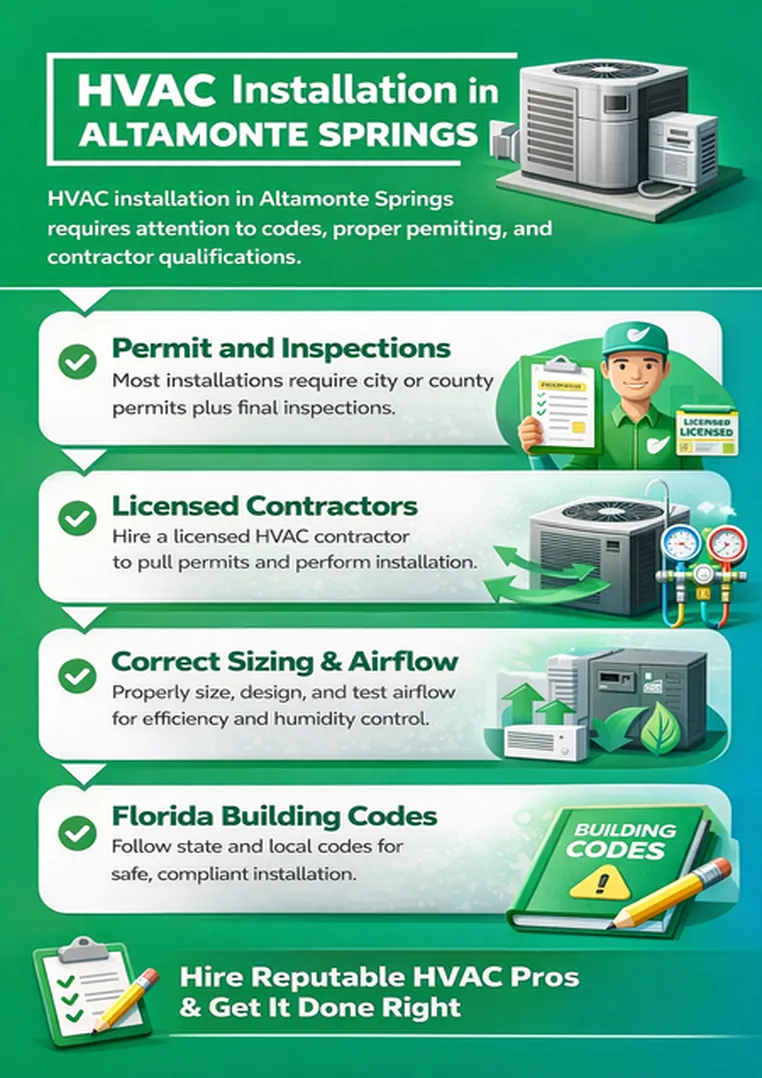
HVAC installation in Altamonte Springs requires proper permitting, licensed contractors, and correct system sizing to meet local code and perform well in Florida’s heat and humidity. Homes inside city limits are permitted by the City of Altamonte Springs, while unincorporated areas fall under Seminole County. Successful installations prioritize Manual J load calculations, verified licensing, and compliance inspections—not just equipment selection—to ensure long-term comfort, efficiency, and reliability.
Top Takeaways
Permits are jurisdiction-based
City vs. county authority depends on location, not mailing address.Permits and licensing prevent problems
Early verification avoids delays and failed inspections.
Installation quality drives performancePoor sizing or airflow can cut efficiency by up to 30%.
Manual J sizing matters in Florida
Proper calculations prevent humidity and comfort issues.
Better comfort, lower costs, fewer post-install issues.
This page breaks down how HVAC permitting actually works in Altamonte Springs versus unincorporated Seminole County, using real-world permitting scenarios we see regularly. You will learn how to verify which authority applies to your home, what each agency typically requires, and why understanding this difference upfront protects your timeline, budget, and warranty coverage. The goal is not just to explain the rules—but to help you avoid the permitting mistakes that experienced contractors proactively plan around.
When it comes to HVAC permits in Altamonte Springs, the deciding factor is not the type of system you are installing—it is the jurisdiction your home falls under. Although many homeowners assume permits are handled at the county level, Altamonte Springs is an incorporated city with its own building department and permitting authority for properties within city limits.
If your home is located inside the City of Altamonte Springs, HVAC permits are issued and inspected by the City of Altamonte Springs Building Division. This includes system replacements, new installations, and any work involving mechanical, electrical, or structural modifications. City-issued permits typically follow local code interpretations and inspection schedules, which can differ slightly from county processes.
If your property is outside city limits in unincorporated Seminole County, HVAC permits are handled by Seminole County’s Building Division. County permitting applies to neighborhoods that may share an Altamonte Springs mailing address but are not governed by the city itself—a distinction that frequently causes confusion during scheduling and contractor coordination.
From firsthand experience, the fastest way to avoid permitting delays is verifying jurisdiction before installation is scheduled. Address lookups through city or county GIS tools—and working with contractors familiar with both authorities—help ensure permits are filed correctly the first time. Understanding who issues your HVAC permit protects your project timeline, ensures inspections pass without issue, and keeps your installation fully compliant from day one.

“In Altamonte Springs, the timing of HVAC maintenance matters as much as the service itself. From firsthand experience, systems that are serviced before peak heat consistently run more efficiently, break down less often, and last longer than those maintained reactively.”
Essential Resources
Installing a new HVAC system requires more than choosing equipment—it requires clear permitting, verified contractors, proper system sizing, and compliance with Florida regulations. The resources below are non-competitive, authoritative, and homeowner-focused, providing reliable guidance from government agencies and industry standards organizations to help you make informed decisions in Altamonte Springs.
City of Altamonte Springs Building Division
Verify City HVAC Permit and Inspection Requirements
Use this official city resource to confirm whether your home is within Altamonte Springs limits and to review local HVAC permitting, inspection schedules, and code requirements.
https://www.altamonte.org/162/Building
Seminole County Building Division
Understand HVAC Permits for Unincorporated Areas
This resource is essential if your property falls outside city jurisdiction, outlining Seminole County’s HVAC permit application process and inspection standards.
https://www.seminolecountyfl.gov/departments-services/development-services/building
Florida Department of Business & Professional Regulation (DBPR)
Confirm Your HVAC Contractor Is Properly Licensed
Before any installation begins, use this state database to verify contractor licensing, credentials, and compliance history in Florida.
https://www.myfloridalicense.com
U.S. Department of Energy – HVAC Installation Guidance
Learn How Installation Quality Affects Efficiency and Lifespan
This federal resource explains why proper HVAC installation is critical for energy efficiency, comfort, and durability—especially in hot, humid climates like Central Florida.
https://www.energy.gov/energysaver/air-conditioning
ENERGY STAR® Heating and Cooling Systems
Compare High-Efficiency HVAC Equipment
ENERGY STAR helps homeowners evaluate air conditioners and heat pumps using SEER2 ratings and performance benchmarks to support long-term energy savings.
https://www.energystar.gov/products/heating_cooling
Air Conditioning Contractors of America (ACCA) – Manual J
Ensure Your HVAC System Is Correctly Sized
This industry-standard guidance explains residential load calculations used to prevent oversizing, uneven cooling, and humidity control issues common in Florida homes.
https://www.acca.org/standards/technical-manuals/manual-j-residential-load-calculation
U.S. Environmental Protection Agency (EPA) – Refrigerant Regulations
Understand Refrigerant Rules and Environmental Compliance
This resource outlines EPA refrigerant requirements and phase-downs that affect modern HVAC installations and long-term system compatibility.
https://www.epa.gov/section608
Supporting Statistics
The following data points summarize what consistently separates successful HVAC installations from costly mistakes. These statistics reflect real-world outcomes we see repeatedly in Central Florida homes when permitting, sizing, and installation quality are handled correctly.
Key HVAC Installation Statistics
Installation quality directly affects efficiency
Improper HVAC installation can reduce system efficiency by up to 30%.
High-efficiency equipment cannot offset poor sizing or airflow setup.
Source: U.S. Department of Energy (.gov)
https://www.energy.gov/energysaver/maintaining-your-air-conditioner
Oversized systems perform worse in humid climates
Oversizing causes short cycling and poor moisture removal.
Leads to uneven temperatures and faster equipment wear.
Especially problematic in Florida homes during peak humidity.
Source: Air Conditioning Contractors of America (.org)
https://www.acca.org/standards/technical-manuals/manual-j-residential-load-calculation
Proper installation lowers cooling costs
Correctly installed ENERGY STAR–certified systems can reduce cooling energy use by up to 20%.
Savings depend on correct sizing, airflow, and duct performance—not just equipment ratings.
Source: U.S. Environmental Protection Agency (.gov)
https://www.energystar.gov/products/heating_cooling
Licensed contractors reduce compliance risks
Unlicensed HVAC work increases failed inspections and consumer complaints.
Licensing verification lowers the risk of code violations and rework.
Source: Florida Department of Business & Professional Regulation (.gov)
https://www.myfloridalicense.com
Why These Numbers Matter
Efficiency losses show up quickly on energy bills.
Humidity control failures affect comfort and indoor air quality.
Permit and licensing issues delay installations and inspections.
Correct planning delivers measurable, long-term performance benefits.
These statistics reinforce a simple conclusion: HVAC installation success is driven by preparation, verification, and proper execution—not assumptions or shortcuts.
Final Thought
HVAC installation in Altamonte Springs is more than a system swap. It is a coordinated process that involves permitting, licensing, system design, and climate-specific performance planning. The details outlined on this page directly impact comfort, efficiency, and long-term reliability.
What Matters Most
From firsthand experience reviewing Central Florida installations, the most successful HVAC projects consistently include:
Permit clarity from the start
Confirming whether the city or county issues the permit before scheduling work.
Verified, licensed contractors
Reducing inspection failures, rework, and compliance risks.
Proper system sizing
Using Manual J calculations to avoid humidity issues and short cycling.
Installation over equipment assumptions
Performance depends more on execution than brand or SEER rating alone.
Professional Opinion
HVAC systems perform best when engineered for the home—not guessed.
Shortcuts often lead to higher energy bills and comfort complaints.
Planning for compliance and performance upfront saves time and cost later.
Final Takeaway
In Altamonte Springs’ demanding heat and humidity, successful HVAC installations are built on preparation, verification, and precision. Homeowners who take these steps upfront consistently experience better comfort, lower operating costs, and long-term peace of mind.
Next Steps
Use the steps below to avoid delays, failed inspections, and performance issues when installing an HVAC system in Altamonte Springs.
1. Confirm Permitting Authority
Determine if your home is within Altamonte Springs city limits or unincorporated Seminole County.
Verify jurisdiction before scheduling work.
2. Verify Contractor Licensing
Confirm the contractor is actively licensed in Florida.
Ensure the license covers HVAC installation.
3. Require Proper System Sizing
Ask for a Manual J load calculation.
Avoid sizing based on square footage alone.
4. Clarify Permit and Inspection Roles
Confirm who pulls the permit.
Ask how and when inspections are scheduled.
5. Choose Equipment Strategically
Select systems suited for Florida heat and humidity.
Focus on airflow and moisture control, not just SEER ratings.
6. Organize Your Documentation
Keep permits, inspections, warranties, and load calculations.
Protect resale value and warranty coverage.
7. Proceed With Installation
Schedule installation only after all steps above are complete.
Preparation leads to smoother installs and better performance.
FAQ
Q1: Is a permit required for HVAC installation in Altamonte Springs?
A: Yes.
Most HVAC installations require a permit.
Permits are issued by the city or county based on jurisdiction.
Q2: How do I know who issues my HVAC permit?
A:
It depends on city limits, not mailing address.
Use an official city or county address lookup.
Q3: Who pulls the HVAC permit?
A:
Typically the licensed contractor.
Confirm this before installation begins.
Q4: Why is Manual J sizing important in Altamonte Springs?
A:
Prevents oversizing and short cycling.
Improves humidity control in Florida’s climate.
Extends system lifespan.
Q5: What should I confirm before approving HVAC installation?
A:
Permitting authority.
Contractor licensing.
Manual J load calculation.
Inspection requirements.
Learn more about HVAC Care from one of our HVAC solutions branches…
Filterbuy HVAC Solutions - Miami FL - Air Conditioning Service
1300 S Miami Ave Apt 4806 Miami FL 33130
(305) 306-5027
https://maps.app.goo.gl/Ci1vrL596LhvXKU79