Your Sanford HVAC system is supposed to filter allergens out — not push them back into every room.
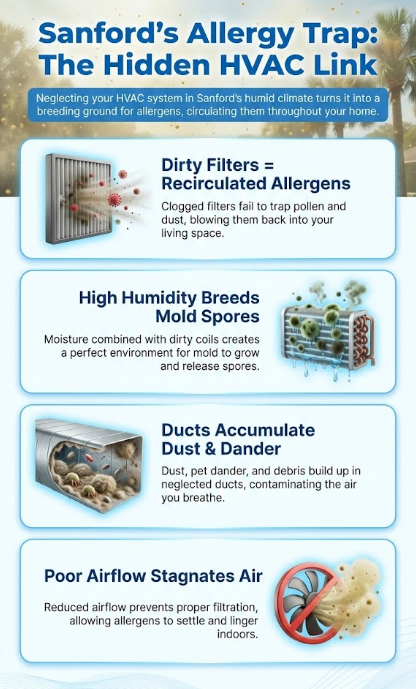
Sanford's year-round pollen cycle and persistent humidity create a double threat most homeowners underestimate. Mold spores, dust mites, and pet dander don't just float in from outside. They accumulate inside your ductwork and cling to clogged filters, and every time your system kicks on, it redistributes them at full force.
We see this pattern constantly. After manufacturing millions of air filters, we've learned that most indoor allergy problems in humid Central Florida climates trace back to one overlooked habit — infrequent filter replacement combined with skipped seasonal maintenance. Customers tell us they tried medications, air purifiers, and even professional duct cleaning before realizing a properly rated filter on a consistent replacement schedule was the missing piece.
Here's what this page covers — how neglected HVAC maintenance compounds allergy symptoms specific to Sanford's climate, which maintenance steps deliver the biggest impact, and why filter selection matters more than most homeowners realize.
TL;DR Quick Answers
HVAC Maintenance in Sanford
Sanford's subtropical climate puts more demand on HVAC systems than most U.S. markets. Year-round pollen, persistent humidity above 50%, and systems running 8 to 12 months per year mean standard national maintenance guidelines fall short here.
What Sanford homeowners need to know:
Filter replacement: Every 45 to 60 days — not 90. Sanford's conditions load filters nearly twice as fast as temperate climates.
MERV rating: 8 to 13 for residential systems. MERV 11 is the best balance for most Central Florida homes dealing with pollen, mold, and dust mites.
Humidity management: Keep indoor levels between 30% and 50%. Above that threshold, mold and dust mites establish inside ductwork and on evaporator coils.
Professional service: Annual coil, drip pan, and duct inspection. These components harbor allergens your filter can't reach.
Permits: Required for installations, replacements, and ductwork modifications under Seminole County building code. Verify contractor licensing at MyFloridaLicense.com.
After manufacturing millions of air filters and working with homeowners across Central Florida, we've found that the single highest-impact maintenance step is also the simplest — the right filter on the right schedule for Sanford's specific conditions.
Top Takeaways
A neglected HVAC system recirculates allergens instead of removing them. Clogged filters push pollen, mold spores, and dust mite debris back into every room, every cycle.
Sanford's climate cuts standard filter life nearly in half. Expect 45 to 60 days — not 90 — due to year-round pollen, high humidity, and nonstop system runtime.
MERV 8 to 13 is the sweet spot for residential allergy relief. Low enough to maintain airflow. High enough to capture the fine particulate driving your symptoms.
Indoor air is 2 to 5 times more polluted than outdoor air. Sanford's closed-window, year-round runtime conditions push that ratio toward the top of the range.
The fix is a correct filter on the right schedule. After working with thousands of Central Florida homeowners, we've found these two changes resolve most indoor allergy complaints — often within days.
How Your HVAC System Becomes an Allergy Trigger in Sanford
A functioning HVAC system pulls air through a filter, traps airborne particles, and circulates cleaner air back into your living space. That cycle happens dozens of times per day. When the system is properly maintained, it removes a significant percentage of the pollen, dust mite debris, mold spores, and pet dander floating through your home.
The problem starts when maintenance falls behind. A saturated filter can't trap new particles — it becomes a surface where allergens collect and eventually break free back into your airflow. We've seen filters pulled from Sanford homes so loaded with particulate that airflow was reduced by nearly half. At that point your system isn't filtering anything. It's just moving contaminated air faster.
Sanford's subtropical climate makes this worse than most homeowners realize. Year-round pollen from oak, pine, and grass cycles overlapping across nearly every month means filters work harder here. Persistent humidity above 50% lets dust mites reproduce rapidly and mold establishes inside ductwork, drip pans, and around evaporator coils. HVAC units in Sanford run 8 to 12 months per year, pulling in and processing far more contaminants than systems in moderate climates. Customers tell us they go through filters noticeably faster here than the manufacturer's suggested timeline — and that's expected. A filter rated for 90 days in a temperate climate may reach capacity in 45 to 60 days in Sanford's conditions.
The Maintenance Gaps That Worsen Allergy Symptoms Most
Not all maintenance failures carry the same weight. Based on what we've seen across thousands of customer situations, these are the oversights that contribute most directly to worsening allergy symptoms.
Skipping filter replacements. This is the single most common cause. A filter past its capacity does more harm than having no filter at all because it restricts airflow while releasing trapped particles back into circulation.
Ignoring ductwork buildup. Even with regular filter changes, dust and biological material accumulate inside ducts over time. Every system cycle pushes a small amount of that buildup into your rooms.
Neglecting the evaporator coil and drip pan. In Sanford's humidity, these components grow mold quickly. That mold becomes airborne the moment your system runs.
Using the wrong MERV rating. A filter with too low a MERV rating lets the particles most responsible for allergy symptoms — those between 1 and 10 microns — pass straight through.
What Proper HVAC Maintenance Looks Like for Sanford Allergy Relief
Resolving HVAC-related allergy issues in Sanford doesn't require a major investment. It requires consistency and the right filter selection.
Replace filters on a Sanford-adjusted schedule. For standard 1-inch filters, check monthly and plan on replacing every 30 to 60 days rather than the standard 90-day recommendation. Homes with pets or multiple occupants should lean toward the shorter end.
Choose a MERV rating between 8 and 13. This range captures the fine particulate responsible for most allergy symptoms — including pollen, mold spores, and dust mite debris — without restricting airflow beyond what residential systems can handle.
Schedule professional duct and coil cleaning annually. This eliminates the allergen reservoir that builds up in places your filter can't reach.
Monitor indoor humidity. Keep levels between 30% and 50%. A dehumidifier paired with consistent HVAC maintenance makes a measurable difference in Sanford homes.
After manufacturing millions of filters and working with homeowners across Central Florida, we've found that the combination of correct MERV rating and disciplined replacement schedule resolves the majority of indoor allergy complaints — often within the first week.

"After working with thousands of Central Florida homeowners, we've found that the number one reason allergies get worse indoors isn't the pollen count outside — it's a filter that's been in the system 30 days past its limit, quietly recirculating everything it was supposed to catch."
7 Essential HVAC Maintenance Resources Every Sanford Homeowner Needs
1. EPA Guide to Improving Indoor Air Quality — Understand What You're Breathing
The U.S. Environmental Protection Agency explains how your HVAC system controls the pollutants circulating inside your home. Start here to understand why ventilation, filtration, and routine maintenance are the foundation of healthier indoor air in humid climates like Sanford.
URL: https://www.epa.gov/indoor-air-quality-iaq/improving-indoor-air-quality
2. U.S. Department of Energy Air Conditioner Maintenance Guide — Learn What You Can Do Yourself
The DOE's official maintenance guide walks homeowners through filter replacement, coil cleaning, fin straightening, and seasonal system preparation. Use this to identify which tasks you can handle between professional service visits and which require a licensed technician.
URL: https://www.energy.gov/energysaver/air-conditioner-maintenance
3. ENERGY STAR HVAC Maintenance Checklist — Know What a Professional Visit Should Include
This checklist details every inspection point a qualified contractor should cover during a routine service call. Print it before your next appointment so you can verify your Sanford HVAC technician is checking thermostat calibration, electrical connections, refrigerant levels, condensate drains, and blower components.
URL: https://www.energystar.gov/saveathome/heating-cooling/maintenance-checklist
4. ASHRAE Filtration and Disinfection FAQ — Choose the Right Filter for Your System
ASHRAE created the MERV rating system that the entire HVAC industry uses to measure filter performance. Their FAQ answers the most common questions about which MERV rating matches your system's airflow capacity and your household's air quality needs.
URL: https://www.ashrae.org/technical-resources/filtration-and-disinfection-faq
5. Seminole County Building Division — Check Local Permit Requirements Before Any HVAC Work
Sanford falls under Seminole County's building code jurisdiction. Florida law requires permits for HVAC installations, replacements, and ductwork modifications. Verify requirements here before authorizing any work to avoid failed inspections or code violations.
URL: https://www.seminolecountyfl.gov/departments-services/development-services/building
6. Florida DBPR License Verification Portal — Confirm Your Contractor Is Licensed
The Florida Department of Business and Professional Regulation requires every HVAC contractor to hold a valid state license. Search by name or license number to verify credentials before any technician works on your Sanford home.
URL: https://www.myfloridalicense.com/wl11.asp
7. ACCA Homeowner Resources — Find a Qualified HVAC Contractor
The Air Conditioning Contractors of America writes the national standards for HVAC installation and maintenance quality. Their homeowner resource center helps you understand what professional service should look like and how to identify contractors who follow industry best practices.
URL: https://www.acca.org/homes
Supporting Statistics
1. Indoor air pollution is 2 to 5 times higher than outdoor levels — and Sanford's climate pushes it toward the higher end.
The EPA reports that indoor pollutant concentrations regularly exceed outdoor air by a factor of 2 to 5. In Sanford, the conditions that drive that number up are constant:
Windows stay closed most of the year.
HVAC systems run nearly nonstop for 8 to 12 months.
Indoor air recirculates through the same ductwork and filter hundreds of times without a break.
Customers tell us they assumed their allergies were seasonal — until they realized the real exposure was happening inside their own homes. A properly maintained system with the right filter is the only mechanical barrier between your family and that concentrated indoor air.
Source: U.S. Environmental Protection Agency — Indoor Air Quality https://www.epa.gov/report-environment/indoor-air-quality
2. A clogged filter increases HVAC energy consumption by up to 15% — and Central Florida filters hit that point faster than most homeowners expect.
ENERGY STAR identifies dirt and neglect as the top causes of system failure and inefficiency. After manufacturing millions of filters and tracking replacement patterns across climate zones, here's what we've found specific to Sanford:
A filter rated for 90 days in a northern climate reaches full capacity in 45 to 60 days here.
Year-round pollen, persistent humidity, and extended runtime accelerate filter loading.
Homeowners following generic replacement timelines are likely running a restricted system for weeks without knowing it.
The result is higher energy bills and declining air quality — both entirely preventable with a Sanford-adjusted replacement schedule.
Source: ENERGY STAR — HVAC Maintenance Checklist (U.S. Department of Energy) https://www.energystar.gov/saveathome/heating-cooling/maintenance-checklist
3. Roughly 1 in 3 U.S. adults has a diagnosed allergic condition — which means most Sanford households include someone whose symptoms depend on what their HVAC system filters.
CDC data shows 25.7% of adults reported a seasonal allergy in 2021, with total allergic conditions affecting nearly one-third of the population. We hear from these homeowners every day. The most common pattern:
Allergy symptoms are managed with medication for months or years.
Multiple solutions tried — air purifiers, duct cleaning, more frequent vacuuming.
A switch to a properly rated MERV filter on a consistent, climate-adjusted replacement schedule.
Noticeable reduction in indoor triggers within days.
The medication addresses symptoms. The right filter addresses the source.
Source: Centers for Disease Control and Prevention — NCHS Data Brief No. 460 https://www.cdc.gov/nchs/products/databriefs/db460.htm
Final Thought
Most advice about HVAC maintenance and allergies is generic. Change your filter. Schedule a tune-up. Keep your vents clear. That guidance isn't wrong — but it misses the point for homeowners in a climate like Sanford's.
Sanford's subtropical conditions don't just make HVAC maintenance important. They make standard maintenance timelines inadequate.
Year-round pollen overlaps across oak, pine, and grass cycles.
Persistent humidity above 50% driving mold and dust mite reproduction.
Systems running 8 to 12 months per year with no seasonal downtime.
The data backs this up:
EPA: Indoor pollutant levels run 2 to 5 times higher than outdoor air.
ENERGY STAR: A clogged filter costs you up to 15% in energy efficiency.
CDC: Roughly 1 in 3 U.S. adults has a diagnosed allergic condition.
Those statistics describe the problem. They don't tell you how straightforward the solution actually is.
Here's our honest take after manufacturing millions of air filters and working with Central Florida homeowners for years. The vast majority of indoor allergy complaints we hear trace back to two overlooked habits:
Using a filter with too low a MERV rating.
Leaving it in the system past its effective life.
Not a failing HVAC unit. Not a ductwork problem. Not something that requires an expensive fix.
We've watched homeowners spend hundreds on air purifiers, medications, and professional duct cleaning before trying the one thing that costs a few dollars and takes 30 seconds — replacing their filter with the right MERV rating on a schedule adjusted for Sanford's conditions.
When they do, the difference shows up fast:
Fewer allergy symptoms indoors.
Lower monthly energy bills.
A system that runs the way it was designed to.
If your allergies are worse inside your Sanford home than outside, your HVAC system is telling you something. The filter is the first place to look — and in our experience, it's usually the last place homeowners think to check.
FAQ on HVAC Maintenance in Sanford
Q: How often should I replace my HVAC filter in Sanford?
A: Check monthly. Replace every 45 to 60 days — not the 90 days printed on most packaging.
That 90-day number is based on average national conditions. Sanford doesn't have average conditions:
Overlapping pollen seasons across oak, pine, and grass cycles.
Humidity that rarely dips below 50%.
Systems running nearly year-round with no seasonal break.
We've tracked this across millions of filters shipped to Central Florida zip codes. The pattern is consistent — homeowners who wait the full 90 days run a restricted system for the last three to four weeks without knowing it. Homes with pets or multiple occupants should target 30 to 45 days.
Q: What MERV rating is best for homes in Sanford?
A: MERV 8 to 13 for most Sanford residences. Here's how each level performs against Central Florida allergens based on what we've seen:
MERV 8 — handles baseline dust and larger pollen particles effectively.
MERV 11 — captures finer allergens including mold spores and dust mite debris. Best balance for most Sanford homes.
MERV 13 — adds protection for households with asthma or severe sensitivities.
The most common mistake isn't choosing too low. It's jumping to the highest rating without checking system compatibility. An older unit forced to pull air through a filter it wasn't designed for creates the same restriction as a clogged filter. Match the rating to your system's specifications first. Optimize from there.
Q: Does Sanford's humidity affect my HVAC system's performance?
A: It's one of the biggest factors we see — and the one most homeowners underestimate.
Once indoor humidity crosses 50%, which happens routinely here, two things accelerate:
Dust mites reproduce rapidly.
Mold colonizes the places you can't see — inside ductwork, on evaporator coils, and in drip pans.
We hear from customers who replaced their filter on schedule, kept a clean home, and still had persistent symptoms. Almost every time the culprit is the same — mold growth on the coil or in the drain pan. Your filter alone can't reach these components. Annual professional cleaning isn't optional in this climate. It's essential.
Q: Do I need a permit for HVAC work in Sanford?
A: For anything beyond basic maintenance, yes.
Sanford falls under Seminole County's building jurisdiction. Florida law requires permits for:
System installations.
Full system replacements.
Ductwork modifications.
Filter changes, standard tune-ups, and thermostat adjustments do not require a permit.
From experience, we'd strongly recommend verifying two things before authorizing any major HVAC work:
Confirm your contractor holds a valid Florida DBPR license at MyFloridaLicense.com.
Confirm they are pulling the permit themselves.
A licensed contractor who hesitates on either point is a red flag. Seminole County's Building Division website has full permit requirements and an online lookup tool.
Q: What are the signs my HVAC system is making my allergies worse?
A: This is the question we hear most from Sanford homeowners. The clearest indicator is a pattern — symptoms improve when you leave the house and return within an hour of coming home. That tells you indoor air is the primary trigger, not outdoor pollen.
Other signs we consistently see:
Dust reappears on surfaces within a day or two of cleaning.
Stale or musty smell when the system first kicks on.
Uneven airflow between rooms — some stuffy, others fine.
Symptoms that don't follow the outdoor pollen calendar.
When homeowners describe this pattern, the first thing we ask is how old their filter is and what MERV rating they're using. In the majority of cases, one of two things is true:
The filter has been in the system past its effective life for Sanford's conditions.
The MERV rating is too low to capture the particulate causing symptoms.
It's the simplest and least expensive fix — and in our experience, the one most people check last.
Stop Your Sanford HVAC System From Making Your Allergies Worse
The right air filter on the right schedule is the fastest way to reduce indoor allergens and take back control of your home's air quality. Find your size, choose your MERV rating, and get it delivered to your door — so your system starts protecting you instead of working against you.Here is the nearest branch location serving the Fort Pierce FL area…
Filterbuy HVAC Solutions - West Palm Beach FL
1655 Palm Beach Lakes Blvd ste 1005, West Palm Beach, FL 33401
(561) 448-3760