15x15x4 Air Filters: Does Higher MERV Mean Cleaner Air?
Pull a used 4-inch MERV 13 out of a residential return after 60 days and weigh it next to a used MERV 11 from a similar home. The MERV 13 holds more dust. That sounds like a win until the airflow log tells the rest of the story, where the blower behind it ran longer, drew more current, and left more dust on the furniture than the home running a MERV 11.
That gap between lab capture and real-home performance is the part of the MERV story most filter packaging never explains. A 15x15x4 air filter at MERV 11 often delivers cleaner indoor air than the same-size filter at MERV 13 because the blower can still move the design airflow through it. The right MERV for any 15x15x4 cabinet depends on who lives in the house, what the air carries, and what the blower is rated to pull.
TL;DR Quick Answers
Does A Higher MERV 15x15x4 Air Filter Always Mean Cleaner Air?
Not always. A higher MERV captures finer particles in the lab, but real-home performance only matches lab numbers when the blower can still pull the design airflow through the denser media. For most 15x15x4 air filters in residential systems, MERV 11 hits the sweet spot for clean air per watt of blower work. MERV 13 is appropriate for homes where someone has a clinical reason for finer filtration, and the blower spec sheet confirms the system can handle the additional pressure drop. MERV 8 still holds its own in households without pets, smokers, or allergy sufferers.
Top 5 Takeaways
A 15x15x4 air filter measures roughly 14.5 by 14.5 by 3.75 inches in the actual slot. Measure before you order.
MERV 8, MERV 11, and MERV 13 capture different particle size ranges. Higher is not automatically better.
The 4-inch depth holds far more media surface area than a 1-inch filter, which lowers pressure drop at any MERV.
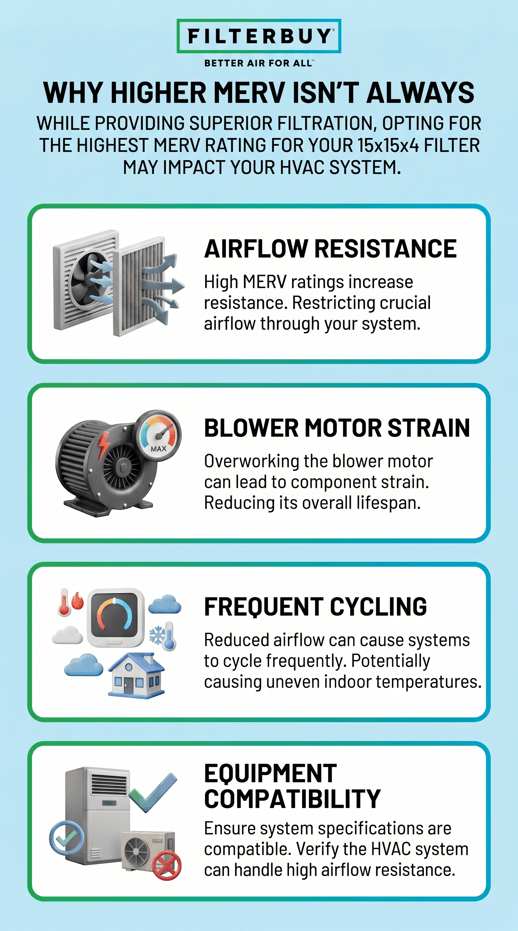
A blower that is not rated for MERV 13 will short-cycle, whistle, or run constantly while fighting the resistance.
For most homes, a MERV 11 in a 15x15x4 cabinet is the cleanest-air-per-watt choice.
What MERV Actually Measures (And What It Does Not)
MERV stands for Minimum Efficiency Reporting Value. The scale runs 1 to 16, and it grades how well a filter captures particles between 0.3 and 10 microns under controlled laboratory conditions defined by ASHRAE Standard 52.2 in 1987.
MERV is the industry-standard rating scale for any residential or commercial air filter, and the number tells you which particle sizes the filter is rated to catch. MERV 8 reliably catches larger particles such as dust, pollen, and mold spores. MERV 11 picks up where MERV 8 stops, adding pet dander and the size range where most household allergens live. MERV 13 reaches into smaller particles still, capturing bacteria carriers, smoke, and the particles that move some viruses through indoor air. Each step up the scale adds material density to the filter media, which raises both capture efficiency and resistance to airflow.
The resistance is the half of the equation that the lab number leaves out. A filter rated for high capture only delivers high capture in your home when the blower can still pull the design airflow through the denser media. When it cannot, the filter starves the system, dust bypasses the media through gaps in the housing and return grille, and the air recirculates dirtier than before. Treat the number on the box as a ceiling. Your system has to be able to reach that ceiling for the filter to deliver what it promises.
The 15x15x4 Size And Why The 4-Inch Depth Matters
A 15x15x4 nominal filter measures approximately 14.5 by 14.5 by 3.75 inches in the actual slot. The half-inch undercut on each side is industry standard, and it is what lets the filter slide cleanly into the cabinet without binding against the housing. Confirm both the slot width and depth before ordering. A 15x15x4 is less common than 16x25x4 or 20x25x4, and a slot that looks square can still vary by a quarter inch depending on the cabinet manufacturer.
The four-inch depth is the part of the size that does the real work. A 4-inch pleated filter holds roughly four times the media surface area of a 1-inch filter at the same nominal face size. That additional surface area is what lets the filter capture more particles without choking the system. Pressure drop across a 4-inch MERV 11 often sits lower than pressure drop across a 1-inch MERV 8 in the same cabinet, because the air has more pleats to flow through. The depth also extends service life. Most 4-inch filters run 60 to 90 days, whereas a 1-inch filter at the same MERV typically lasts about 30.
Specs at a glance for a typical 15x15x4 pleated air filter:
Nominal size: 15 by 15 by 4 inches
Actual size: approximately 14.5 by 14.5 by 3.75 inches
Available MERV ratings: 8, 11, and 13 in standard residential options
Construction: Pleated synthetic media in a beverage-board or galvanized steel frame
Recommended service life: 60 to 90 days for most homes, shorter with pets or heavy cooking
Origin: Made in the USA when sourced from Filterbuy
After manufacturing filters for over a decade and serving more than two million households, we have learned that the depth of the filter matters as much as the MERV number on the label.
MERV 8 Vs. MERV 11 Vs. MERV 13 In A 15x15x4 Slot
Picking between the three common MERV ratings for a 15x15x4 cabinet comes down to who lives in the house, what the air carries, and what the blower is rated to pull.
MERV 8
MERV 8 catches dust, pollen, and mold spores at the larger end of the particle scale, generally down to about three microns. It fits households without pets, smokers, or anyone managing allergies. The pressure drop stays low, and the cost per filter is the lowest of the three options, which means the system runs the way the manufacturer designed it to run. Low-occupancy homes, second homes, rental properties, and homes in dry climates all do well at MERV 8, especially when the goal is protecting the equipment rather than chasing finer filtration.
MERV 11
MERV 11 catches everything MERV 8 picks up, plus pet dander, finer dust, and the size range where most household allergens live. This is the 15x15x4 allergen filter most homeowners actually want when they reach for a MERV 13 by mistake. In a 4-inch cabinet, the pressure drop sits within the spec range of nearly every residential blower built in the last twenty years. Homes with pets, mild allergies, or visible dust accumulation between cleanings see the biggest practical gain when they move up to MERV 11.
MERV 13
MERV 13 reaches into bacteria-sized particles, smoke, and the carriers that move some viruses through indoor air. The pressure drop is the catch. A blower rated for a maximum of 0.5 inches water column of static pressure may push past its design point trying to overcome a clean MERV 13, and the problem gets worse as the filter loads with dust. Cleaner indoor air also produces downstream effects beyond particle capture, including the environmental benefits of a properly sized furnace filter across energy use and system longevity. Households with a documented clinical reason for finer filtration and a blower spec sheet that confirms the extra resistance is within range will get the most value out of MERV 13.
How To Read Your Blower Spec
Find the static pressure rating on the data plate inside the air handler door, or in the installer's manual if the plate is missing. The number is usually expressed as inches of water column at a specific cubic feet per minute airflow rating. Cross-reference that figure against the pressure drop curve printed on the filter manufacturer's spec sheet at the same airflow rate. If the clean filter already uses half the available headroom, the system will struggle once the filter loads with dust. That is the moment a MERV 11 in a 4-inch cabinet outperforms a MERV 13 in real-world airflow.
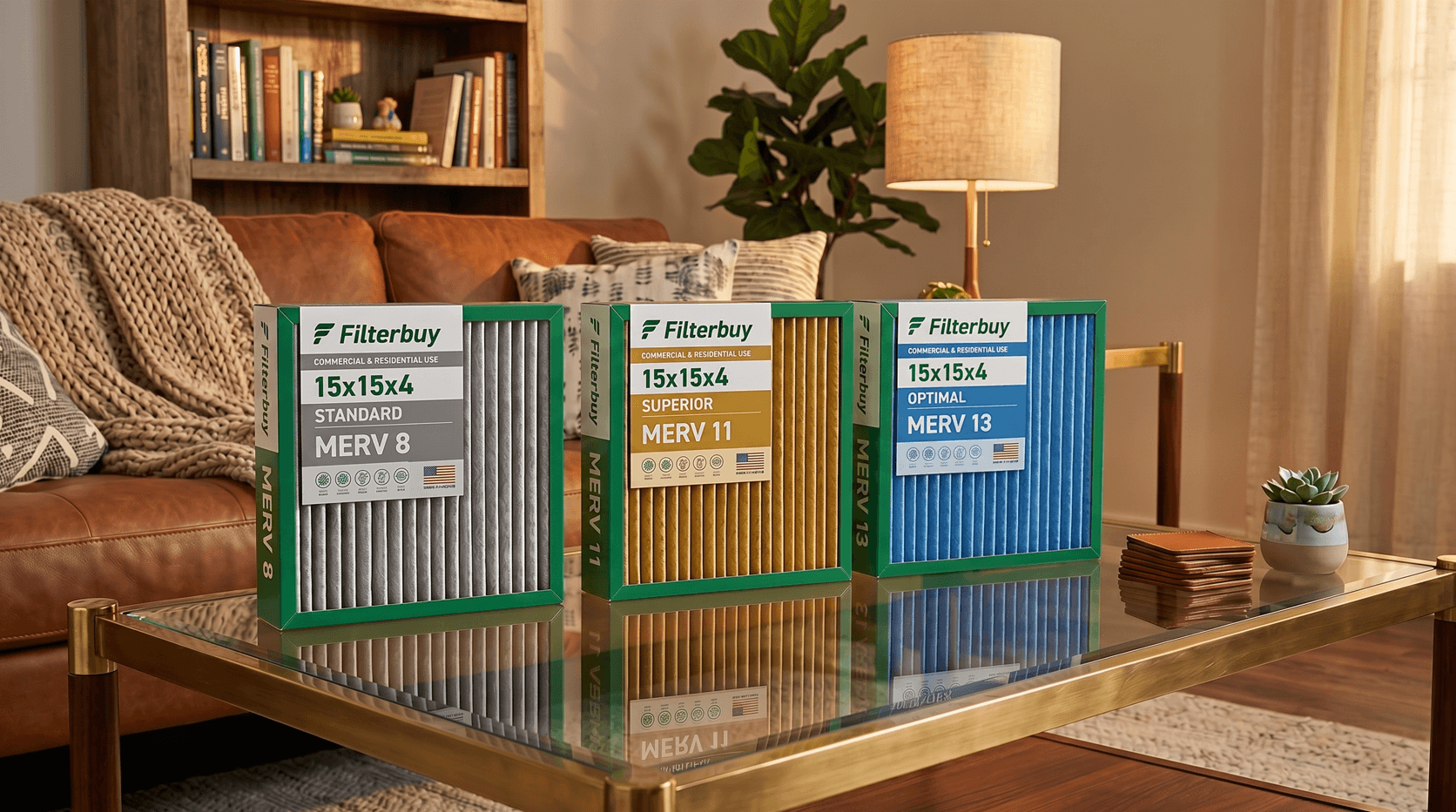
"Inside our manufacturing facilities, we have run enough airflow tests on 15x15x4 cabinets to see a consistent pattern. A 4-inch MERV 11 holds steadier pressure drop across a 90-day service life than a 4-inch MERV 13 in the same blower. The home actually gets more filtered air over the life of the filter, even when the MERV number on the box is lower."
Essential Resources On 15x15x4 Air Filters
Seven resources from independent .gov and .org sources. Each one fills a different gap in what most homeowners need to know before picking a MERV rating for a 4-inch cabinet.
1. The Plain-English Federal Primer On Whole-Home Filtration
The Environmental Protection Agency walks homeowners through how HVAC filters and portable air cleaners actually compare, including the specific pollutants each one is designed to address.
Source: EPA Guide to Air Cleaners in the Home
2. The Standards Body Behind The MERV Rating Itself
ASHRAE wrote the test method that produces the MERV scale, and their position document explains why higher MERV does not translate into linear gains in actual indoor air quality.
Source: ASHRAE Position Document on Filtration and Air Cleaning
3. Federal Health Guidance On Filter Choice And Replacement Frequency
The Centers for Disease Control and Prevention recommends pleated filters and a 90-day replacement schedule as part of routine respiratory health practice. It is the clearest federal voice on day-to-day HVAC filter maintenance.
Source: CDC Taking Steps for Cleaner Air for Respiratory Virus Prevention
4. How Filter Choice Affects HVAC System Efficiency
The Department of Energy spells out why dirty or restrictive filters force the system to work harder, raise the energy bill, and shorten equipment life. Read this before assuming a higher MERV is automatically the better long-term investment.
Source: U.S. Department of Energy Air Conditioner Maintenance Guide
5. Industry-Written Best Practices For Filter Selection
The National Air Filtration Association publishes guidelines drawn from the working experience of air filter distributors, manufacturers, and engineers across residential, commercial, and specialty applications. It is the trade-level companion to the ASHRAE testing standard listed above, and the same group that drove the development of ASHRAE 52.2 in the first place.
Source: NAFA Best Practice Guidelines for Air Filtration
6. Filter Selection For Allergy And Asthma Households
The Asthma and Allergy Foundation of America covers what to look for in an air cleaner or filter when someone in the home has allergies or asthma, including the difference between CADR and MERV ratings.
Source: AAFA Air Cleaners: What You Need to Know
7. The Research Foundation On Indoor Air And Health
The National Institute of Environmental Health Sciences summarizes the peer-reviewed research linking indoor air pollutants to health outcomes. It is the long view on why filter choice matters beyond comfort.
Source: NIEHS Indoor Air Quality Research Overview
Supporting Statistics
Three numbers from federal and independent research sources that frame the stakes around the 15x15x4 filter choice.
Air conditioning accounts for roughly 19 percent of electricity used in U.S. homes, or about 254 billion kilowatt-hours a year. A restrictive filter that keeps the blower running longer pushes that share even higher.
Source: U.S. Energy Information Administration Residential Air Conditioning Electricity Use
Roughly 55 percent of U.S. homes are running an air filter rated MERV 6 or lower, which captures only about 7 percent of fine particulate matter from indoor air. Moving up to a MERV 11 or 13 in a 4-inch cabinet is where the real gain shows up.
Source: National Academies Health Risks of Indoor Exposure to Particulate Matter Workshop Summary
A large-scale residential PM2.5 study across nearly 4,000 U.S. homes found that outdoor sources contribute a median 52 percent of total indoor PM2.5, with cooking and persistent indoor sources making up the rest. HVAC filtration is the primary defense against the outdoor share.
Final Thoughts And Opinion
For most homes running a 15x15x4 cabinet, MERV 11 is the right answer. It catches the particles that actually move the dial on dust accumulation and allergy symptoms, and it does so without forcing the blower to work overtime. MERV 13 earns its place when a household member has a clinical reason for finer filtration, and the blower spec sheet confirms the system can handle the pressure drop. MERV 8 still does its job in households without pets, smokers, or sensitivities.
The cabinet size itself does a lot of the work. A 4-inch filter at MERV 11 captures more total particulate per service cycle than a 1-inch filter at the same MERV rating, because the extra depth holds more media and runs at lower pressure drop.
If the standard 15x15x4 size does not match the slot exactly, a custom 15x15x4 air filter built to your actual measurements is worth the extra step. A loose filter lets dust bypass the media and re-enter the duct system, which cancels out whatever MERV rating you bought.
 Frequently Asked Questions
Q: What Is The Actual Size Of A 15x15x4 Air Filter?
A: A 15x15x4 nominal filter measures approximately 14.5 by 14.5 by 3.75 inches in the slot. The half-inch undercut on each side is industry standard, so the filter slides cleanly into the cabinet. Measure the slot before ordering, because some cabinet manufacturers vary by a quarter inch.
Q: How Long Does A 15x15x4 Furnace Filter Last Before Needing Replacement?
A: 60 to 90 days is the standard service window for most homes. Households with pets, smokers, or heavy cooking should plan on the shorter end of that range. The 4-inch depth holds more dust than a 1-inch filter, which is why the replacement interval runs longer.
Q: Are There Carbon Or Allergen Variants Of A 15x15x4 Air Filter?
A: Yes. A 15x15x4 carbon air filter adds an activated carbon layer for odor and VOC reduction. An allergen-focused 15x15x4 typically sits at MERV 11 or MERV 13 with finer pleat media. Both add a small amount of pressure drop, so confirm the blower can handle the rating before ordering.
Q: Can I Use A 15x15x4 AC Filter And A Furnace Filter Interchangeably?
A: In residential ducted systems, yes. The 15x15x4 AC filter and the 15x15x4 furnace filter are the same physical filter installed in the same cabinet. The naming reflects which season the homeowner happens to be thinking about, not a different product.
Q: Where Can I Buy A 15x15x4 Air Filter?
A: 15x15x4 is a less common size than 16x25x4 or 20x25x4, so big-box retailers may not stock it in every store. Online specialty manufacturers carry it in single packs, 4-packs for bulk pricing, and custom-cut sizes when the slot does not match a nominal dimension exactly. A search for "15x15x4 air filter near me" usually turns up online options faster than in-store inventory.
Get The Right 15x15x4 air filter for your home from FilterBuy
Higher MERV is not the same as cleaner air. Pick the 15x15x4 rating that matches your household, your blower, and the way you actually live, and Filterbuy will ship it to your door.
Learn more about HVAC Care from one of our HVAC solutions branches…
Filterbuy HVAC Solutions - Miami FL - Air Conditioning Service
1300 S Miami Ave Apt 4806 Miami FL 33130
(305) 306-5027
https://maps.app.goo.gl/Ci1vrL596LhvXKU79